Sunday, July 8, 2012

Fuselage update

Joe Miller asked for some fuselage photos that he could take to Oshkosh, so I took these for him. It was a good chance to move the frame to a clear area and piece it together. It actually looks pretty good (thanks to much work done by Paul Straney). The fuse is now in three pieces, the main fuse, and two small tail sections. If you look closely you can see the gaps near the tail.

I want to comment on weight. It was easy for two people (Paul and me) to pick it up and move it. We each used two hands because of the size, but it was light enough that I could have used one hand if necessary. So, how can something so light support the weight of three adults, wings, and landing gear? Magic, or good ol' US of A design? 


Sorry, I couldn't figure out how to rotate the photo . . . .


Sunday, July 1, 2012

Root Ribs Are DONE!

Yes, the weekly chipping away at the project does have it's payoffs:

Both root ribs, one right, one left.

Front spar slots and lightening holes.

Rear spar slots.

They are the same length, its just the camera angle :-)


Lots of gussets for strength.

Sunday, May 6, 2012

Hi,

We didn't have a work day yesterday because of an airshow that most were attending. So, I thought I would take an opportunity to update you on the progress thus far:

All of the tubing has been removed from the fuse that is not needed. Now the extra tubing will be added.

Ribs are done except for the butt ribs.

Spars need to be ordered for the left wing (right wing later) at a cost of $650. If you would like help move the project forward, please consider making a donation. Thank you.


Sunday, April 29, 2012

Do you speak Draftese?

Drawing has dotted lines. . . ?

The drawing has a set of parallel lines that was confusing for weeks (actually, it was probably months). According to Draftese, dotted lines means a hidden line, which means something is behind something and out of sight. Last week the guys had a brainstorming session and figured out that the something was, and realized it was a reinforcement strip on the back of the rib. They then fabricated the strip and glued it in place as you can see in the photo above.

Chef Joe set up a production line for sandwiches at yesterdays work day.

I took this photo for John (in the middle, Dick on the left, Leo on the right). The photo will be used in an article that John is writing for the Martin Museum Newsletter.

Sunday, April 22, 2012

Butt Ribs

First, I want to set the record straight. I asked around and found out the reason these ribs are called "butt ribs": they "butt" up against the fuselage. Hmm, I shoulda guessed. Oh well.

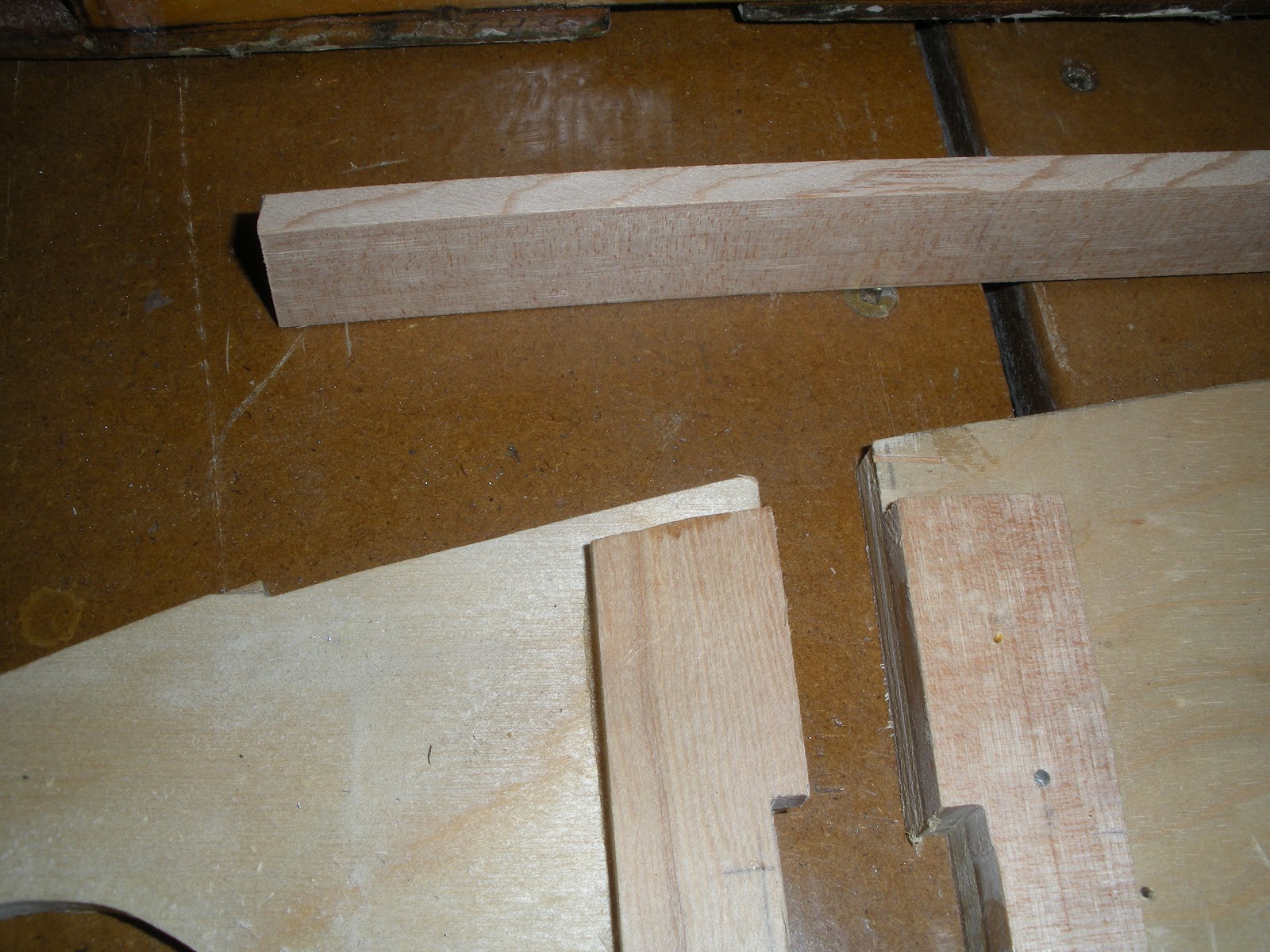
This photo shows the two butt ribs are coming along nicely. I included an old but rib from another similar Aeronca for comparision.

Closeup.

Note: I added the thin strip of wood to the photo that is applied to the top and bottom of the butt rib.

This is how the thin strip of wood is attached to the old butt rib. Note the slot for the spar.

Oops. someone made a notch for the thin wood strip. Not supposed to be there :-(

The good news is that Joe made a right and left butt rib, not two right ribs.

Even the tails of the ribs are made right and left.
BTW. I suppose that if Joe had made two right hand ribs, then we could have said that two rights make a wrong. Sorry, I couldn't resist . . .

Here Joe is filling the unwanted notches with wood strips. I like the clamps. My dad a pair of these, and when you need them (for an irregular shape), nothing else will do.

Closeup of Joe's handiwork.

Close up of old butt rib


Nice hole. 


Sunday, April 15, 2012

Aileron Transition Ribs

Where the end of the ailerons meet the wing's full length rib, a special rib is needed.


Wing rib (cut short to allow for aileron).

Drawing of full length wing rib (i.e. no aileron).
Sorry, I didn't have an appropriate photo :-(

Transition rib.

Now, let me see if I can explain the photo of the transition rib. There are two wood pieces, one tan (on top), and one brown (on the bottom). The brown wood fills the rib and matches the wing where there is "no rib". The tan wood is glued next to the brown wood, and matches the wing ribs where an aileron is located. So, on one side of this transition rib is for an aileron, and on the other side is for "no aileron". Have I totally confused us yet?

Note that because the tan wood is glued to the side of the rib, it sticks out about a quarter of an inch. This is done so that a thin piece of material (wood or thin aluminum) can be attached to it. That piece of thin material is used to close the space at the back of the wing, just in front of the aileron. Are you confused yet?

As time goes by, the above explanation will make more sense. So, please stay tuned as we continue.


Sunday, March 25, 2012

Jig: Gusset Cutter

Leo made this nice jig for cutting gussets in half. Lots of gussets are used on each rib, and lots ribs are used. So, if my math is right, lots of ribs X lots of gussets = gazillions of gussets.

A round gusset, and the jig are sitting on the jig saw, sorry for the pun.

\
Gusset is inserted into the jig. By design it only goes in halfway.

Jig is flipped over, and jig saw is used to cut gusset in half, guided by the edge of the jig.


Note the nice hole for pushing out the other half of the gusset.

Voila. The process is quick, and accurate.

If you look closely, you can see a piece of cardboard was glued into the slot to make a snug fit for the gusset so it didn't fall out during cutting.

Sunday, March 18, 2012

Cool Photo

Paul found this photo.

The photo shows some of the training gliders used during WWII.  If you zoom in, you can read the printing.  The four gliders on the top right are TG-5s, which is the glider we are rebuilding.  The rest are a mixture of TG-19s, TG-15s, PS-2, TG-1, TG-2, and SGS 2-8.  Thanks Paul!

Sunday, March 11, 2012

Problem: Wing Strut Bracket

This wing strut bracket is bent on the left side and will need to be straightened.

This bracket has not been damaged.

Bending the bracket may require some heat. Stay tuned.

Sunday, March 4, 2012

Problem: Landing Gear Bracket

This is the mounting bracket for one side of the landing gear. Remember, the fuselage is upside down.

Yeah, ugly!

View from the rear of the fuse.

This will be a bit of a challenge. The metal is torn, and will probably have to be replaced (maybe just the left half of the bracket). The bracket is welded into the frame where lots of tubes are joined. Originally, holes in the bracket allowed the tubes to be inserted into the bracket, then the whole joint was welded. It will probably take quite a bit of fabrication (new bracket) and disassembly to make it suitable for reassembly and welding.

Center landing bracket.

This bracket resides between the other two. It is bent, and will need some straightening. Maybe some heat from a gas torch will help.

Sunday, February 26, 2012

Success!

Front cross brace has been removed

Note: Paul has flipped the fuselage upside down to make it easier to work on, so it looks different from the last photos.

Now there is room for the instructors feet, ha.

A joint after the removal of the cross brace, lots of work needed (fill with weld).

Only a little bit of filling needed on this joint.


BTW, notice that the paint has been sanded to prep it for the welding. Sanding is used because it does not introduce any elements to the metal that could contaminate the weld.

Sunday, February 19, 2012

Rib Nose Pieces


Dick is sanding a rib nose piece on an oscillating spindle sander.

Careful, slow is good.

The nose piece was cut on a jig saw, then sanded on the oscillating spindle sander.  It is important to be careful because the speed of the sander, combined with the up and down oscillating action, will remove lots of wood very fast. Dick is using very gentle pressure to remove the last little bit so the nose piece is the exact needed size.

There are only four more ribs to be built, then the spars will need to be ordered to continue completion of the wing.

Sunday, February 12, 2012

Leo's latest toys


Nice books

Leo showed me his two new books. As I flipped through them, I felt pangs of envy.  I could easily sit down on a cold winter afternoon with a pot of coffee and read either of these. They have lots of pictures (my favorite type of book), and the text is well written (easy to understand).  They can both be purchased  through the EAA. Click on the following link for more information:


New toy tool, (oops).

Leo bought this, and since I also have one, I wanted to put in a plug for this neat tool. If you have any power sanders (belt sander, spindle, disk, etc.) then you need on of these. It looks and feels like a large pencil eraser, but it removes "stuff" from the sandpaper when it gets clogged. It works like magic.  


Here is how you use it.

Yes, it is as simple as it looks. You just press it against the moving sandpaper, and it magically removes the crud that has filled the valleys.  Below is a picture of a spindle sander that Leo cleaned.

Before

After

If you look closely at the before and after photos you will see that the bottom half is now almost new. This is typical. I have seen old belts restored (in about 5 or 10 seconds) to a brand new condition. This particular spindle had some white stuff at the top that was very stubborn and would not budge. So, as you can see the cleaner isn't perfect, but it normally does wonders. Leo and I can both testify to the usefulness of this device. Also, it lasts a long time. In fact, Leo said he bought it for use at home, but he is going to cut it in half and keep half at home and half at the glider project.

Sunday, February 5, 2012

Christmas in January

Leo and John just received two packages.

Leo received his plywood to make wing gussets.

John received his epoxy.

So, you may ask, "What's the big deal, I can go to the local hardware store and buy these items." The big deal is that these are aviation grade components. That means they have gone through aviation testing that proves they can withstand the riggers of flight. So, when your life depends on it, spend the extra money. It may save your life, and you will not worry about structural failures.